– News Update
Hoteliers Urge Government to Retain 9% VAT
Thursday, 19th January 2023:
Hoteliers Urge Government to Retain 9% VAT
“Now is not the time to jeopardise the recovery in tourism by increasing taxes on Irish consumers and overseas visitors” says IHF President Denyse Campbell
- Hotels and guesthouses facing very challenging economic headwinds over next 12 months
- 81% of hoteliers very concerned about the impact of an increase in VAT on their businesses
- Consumers already squeezed by exceptionally high inflation and pressures on their finances
- British market a major concern with 57% of hoteliers reporting reduced forward bookings for 2023 compared with 2019
Thursday, 19th January 2023: Irish hotels and guesthouses today renewed their call on the Government to retain the 9% tourism VAT rate in response to very challenging economic headwinds facing the sector over the next 12 months. New industry research carried out by the Irish Hotels Federation indicates that the sector is now at crucial juncture as it grapples with economic slowdowns in key overseas markets, escalating business costs and the impact of inflation on discretionary consumer expenditure.
The potential increase in the tourism VAT rate by the Government is a major worry for the sector, with 81% of hoteliers stating they are very concerned about the impact this would have on the outlook for their businesses. This is at a time when consumer confidence is close to decade lows across key tourism markets in the midst of a cost-of-living crisis with consumers dealing with exceptionally high levels of inflation and increases in mortgage interest rates.
Despite an uplift in tourism during the second half of 2022, hotel room occupancy remained significantly lower than pre-pandemic levels. Results reveal that average national room occupancy for stood at 70% in 2022 compared with 78% achieved in 2019. This was largely due to a shortfall in overseas visitors to Ireland, with numbers still down more than 25% last year compared to 2019.
Looking at the year ahead, overseas tourism markets continue to pose a significant challenge for Irish tourism, with many hotels and guesthouses reporting reduced levels of forward bookings compared to the same time in 2019:
- 57% report reduced bookings from Great Britain versus 2019 (12% report an increase, 31% no change)
- 48% report reduced bookings from Northern Ireland (9% report an increase, 43% no change)
- 37% report reduced bookings from the rest of Europe (17% report an increase, 46% no change)
- 41% report reduced bookings from the United States (32% report an increase, 27% no change)
Of particular concern is the bleak economic outlook for the UK with inflation having reached a four-decade high and the country facing the risk of a prolonged recession. This is worrying for hotels and other tourism businesses given the UK has traditionally been our largest source market for overseas visitors. The outlook for the rest of Europe is also concerning as is the impact of the ongoing war in Ukraine. A full recovery to pre-Covid visitor numbers is not expected until 2026 with tourism businesses facing the risk of a softening in demand as a result of a slowdown in the global economy.
Another pressing challenge for the hotels sector is excessive energy costs, with 85% of hotels and guesthouses very concerned about the impact this is already having on their business. Many hotels have experienced increases of upwards of 300% in energy bills compared with 2019 levels. It is estimated that energy costs for the average hotel are now running at 10-12% of total revenue compared with an average of 4% in 2019. Hotels have also experienced unprecedented increases across their entire cost base over the last year including average increases of 25% in the cost of food supplies, beverage costs up 16%, linen and laundry costs up over 30% and insurance costs up 18%.
Denyse Campbell, President of the Irish Hotel Federation expressed deep concern about the impact the proposed VAT increase would have on an industry still recovering from the pandemic.
“With many of our key tourism markets experiencing a cost-of-living-crisis, the last thing the Government should be contemplating is an increase in consumer taxes such as tourism VAT. Consumers in Ireland and across our overseas markets are already being squeezed by exceptionally high levels of inflation and other pressures on their finances, which means there is a very real risk that many will pull back from spending on discretionary items such as holidays and breaks away.
“It is therefore very worrying that Government is considering an increase at this time given the impact it would have on inflation and the damage it would cause to our tourism competitiveness – resulting in Irish consumers and overseas visitors having to pay the third highest tourism VAT rate in all of Europe. Now is not the time to jeopardise the recovery by increasing tourism VAT. The focus of the Government should instead be on safeguarding tourism livelihoods and securing the long-term sustainable recovery of our industry.”
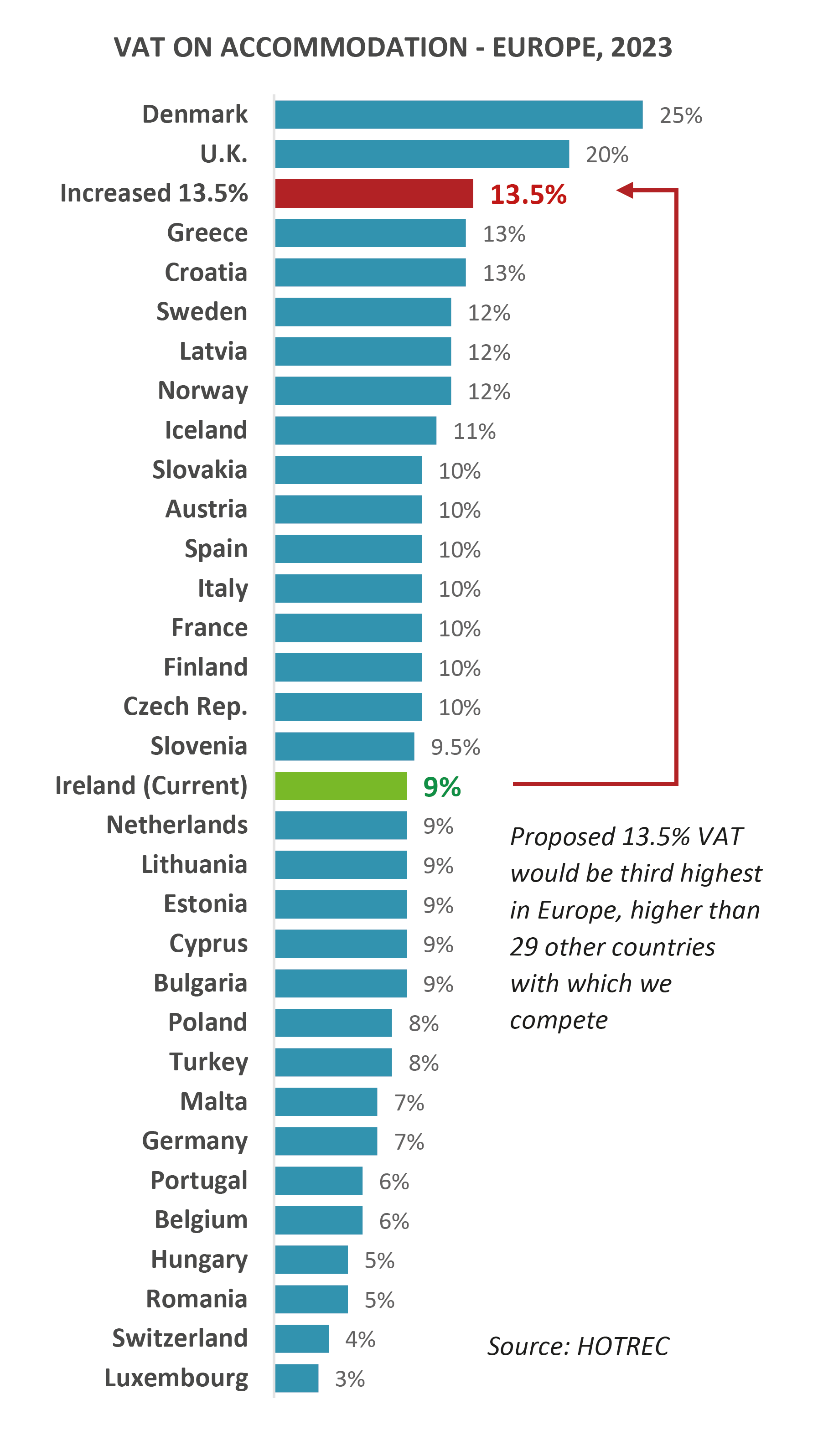
Ms Campbell noted that far from being an exceptional measure, most European countries have a low VAT rate on tourism accommodation. Those European countries that place a high value on tourism as part of their economy, tend to have lower tourism VAT rates. For example, of the 27 EU countries, the VAT rate on accommodation is 9% or lower in 16 countries. In these countries it is settled policy to support tourism with a lower VAT rate as its contribution to tourism jobs, businesses and the wider economy pays its way many times over. This should equally be the case for Irish tourism as our largest indigenous industry, which prior to the pandemic supported over 270,000 livelihoods and contributed €2 billion annually to the exchequer in direct tourism-related taxes.
– ENDS –
For further information:
Káno Communications:
Barry Dunning / Kathryn Moley / Danny Hanley
083 167 4871 / 086 733 4438 / 086 175 9286
* Results based on a survey of owners and general managers of hotel and guesthouse businesses conducted by the Irish Hotels Federation from January 5-13th.
* A chart of European tourism accommodation VAT rates is available to download HERE
About the IHF
Founded in 1937, the Irish Hotels Federation (IHF) is the national organisation of the hotel and guesthouse sector in Ireland. It represents almost 1,000 hotels and guesthouses nationwide, employing over 60,000 people and is a key stakeholder in the Irish tourism industry.